


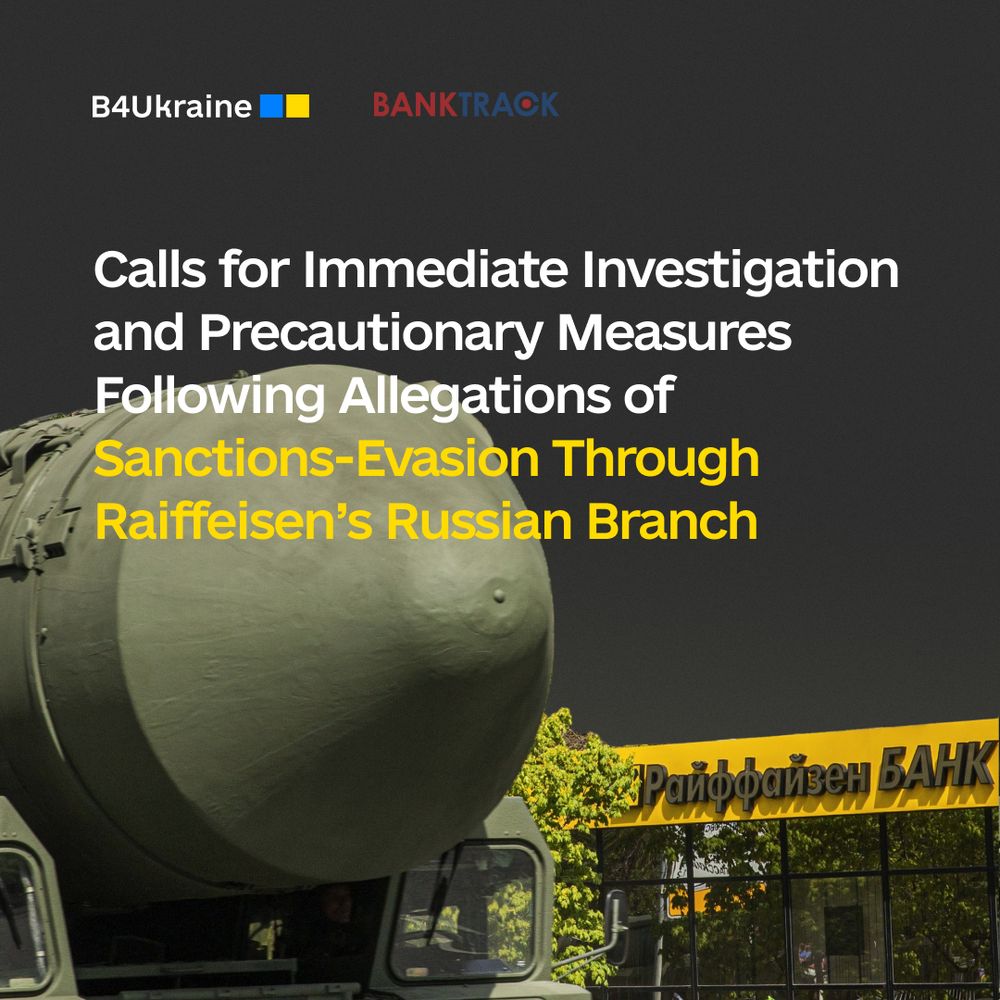


Following a recent report alleging that Raiffeisen Bank’s international payment services facilitated more than $1 billion in imports of sanctioned goods into Russia, as well as trade involving Iran and North Korea, B4Ukraine and Banktrack are calling on the relevant regulatory authorities to immediately investigate the allegations, review Russian bank AO Raiffeisenbank’s continued access to the SWIFT messaging system, and ensure that the Austrian authorities do not authorise the unfreezing of sanctioned shares while those investigations are ongoing. These measures would help ensure that the allegations are fully examined and that no action is taken to alter the status of sanctioned assets or access to international financial infrastructure before the relevant authorities have established the facts.
- Investment analytics firm Grizzly Research says it identified $1.19 billion in Russian trade involving goods covered by EU, US, UK or Swiss import and export restrictions.
- More than $100 million of the transactions allegedly involved heavily sanctioned goods that can support Russia’s military capabilities, including components used in battle tanks and machine tools of the kind used to build nuclear warheads and ballistic missiles.
- Raiffeisen said in a statement that it “categorically denies the allegations.”
As one of the few major international banks still operating in Russia with access to SWIFT, AO Raiffeisenbank’s parent company Raiffeisen Bank International (RBI) has for years claimed to maintain rigorous sanctions compliance and to be exiting its Russian business, despite research by B4Ukraine, BankTrack and others indicating continued ties to sanctioned Russian entities. Grizzly’s findings now cast further doubt on RBI’s claims of compliance with European sanctions.
“Grizzly’s report claims that, by continuing to provide the Russian economy with international payment services, AO Raiffeisenbank is directly enabling Russian customers to continue purchasing goods used for the murder of Ukrainian civilians. European authorities must increase pressure on RBI to accelerate their exit from Russia and publicly disclose which steps they have taken to ensure that AO Raiffeisenbank no longer provides services to clients seeking to undermine EU sanctions legislation,” said Max Hammer, Human Rights Campaigner at BankTrack.
Irrespective of their legality, these transactions underscore crucial weaknesses in the EU sanctions regime which Russian subsidiaries of European banks continue to exploit.
“The EU, which spent hundreds of billions of dollars to help Ukraine defend itself from the aggressor, must ensure that its companies do not undermine these efforts by actively supporting the Russian war effort. EU regulators and legislators place pressure on banks such as RBI to ensure that their services do not benefit the Russian war economy,” said Nezir Sinani, Executive Director of the B4Ukraine Coalition.
EU regulatory bodies, including the Directorate-General FISMA, should encourage Austrian authorities to investigate the data in Grizzly’s reports to assess whether sanctions violations have taken place, as well as encouraging national regulators to develop frameworks to ensure that Russian subsidiaries of EU banks conduct the Enhanced Due Diligence checks required following the December 2025 listing of Russia as a high-risk third country for money laundering.
As the Grizzly report points out, RBI is now seeking to recover assets trapped in Russia not by winding down its Russian operations or closing its Russian subsidiary, but by pursuing a favourable ruling in an Austrian court and an EU sanctions derogation that would unfreeze around €3 billion in assets held by the sanctioned Russian company Rasperia Trading, a company previously owned by oligarch Oleg Deripaska, and transfer them to Raiffeisen.
As B4Ukraine and BankTrack have pointed out, this proposal would set a dangerous precedent, effectively rewarding RBI for failing to manage the risks of its continued Russian operations and their strategic significance to Russia’s war machine. It would also signal to Russian oligarchs that they have a viable route to recovering frozen assets in Europe by using Russian courts to seize EU assets.
Grizzly’s findings place the proposal, which was previously criticised by the US government in 2024 for its possible sanctions-busting implications, in a particularly dubious light and lend new urgency to a global civil society coalition’s call to reject the proposal.
Grizzly’s report also identified more than $10 million in trade with Iran and North Korea carrying the bank’s code, suggesting that the alleged sanctions violations extend beyond Russia. B4Ukraine and BankTrack call on the US Treasury to renew its scrutiny of RBI’s dealings and consider measures to curb the bank’s access to the US financial system if violations are confirmed.
RBI’s share price dropped by 9% following the publication of this report, underscoring the risk that its continued exposure to Russia creates not just for Ukraine, but also for the bank’s shareholders.