


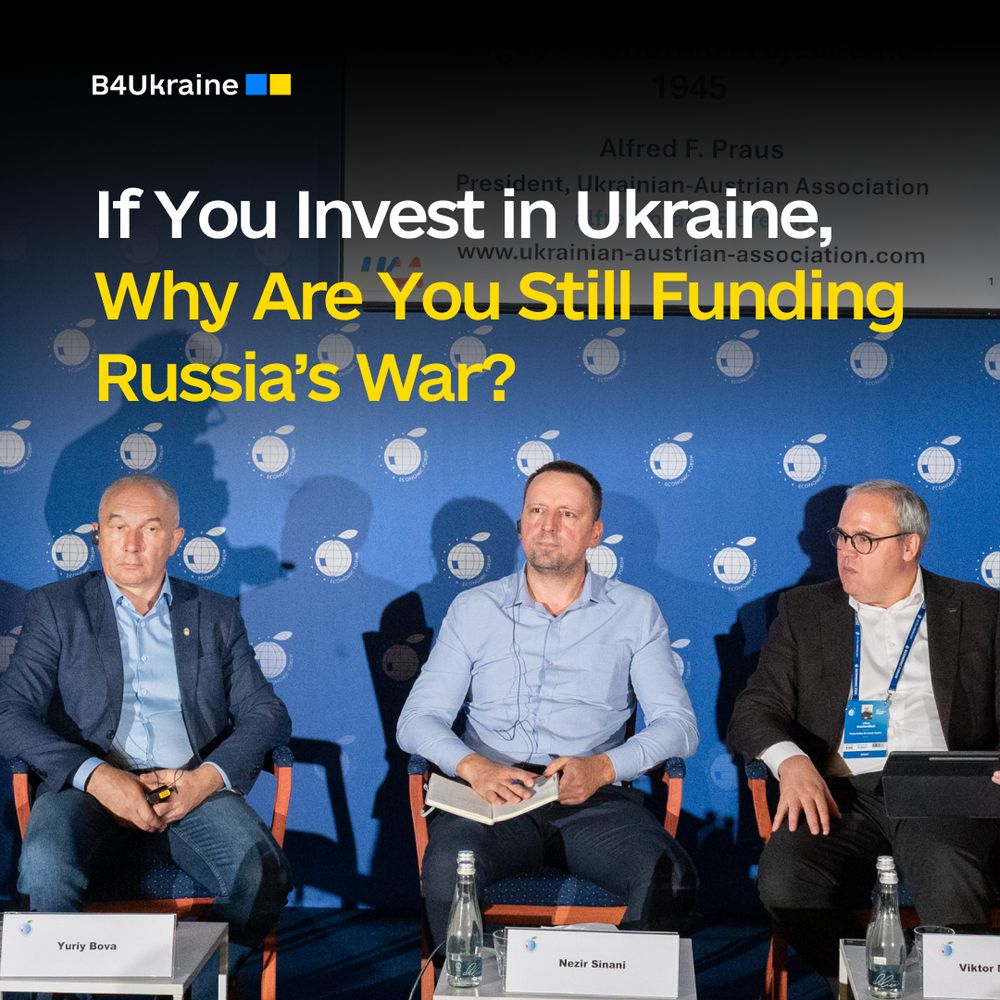


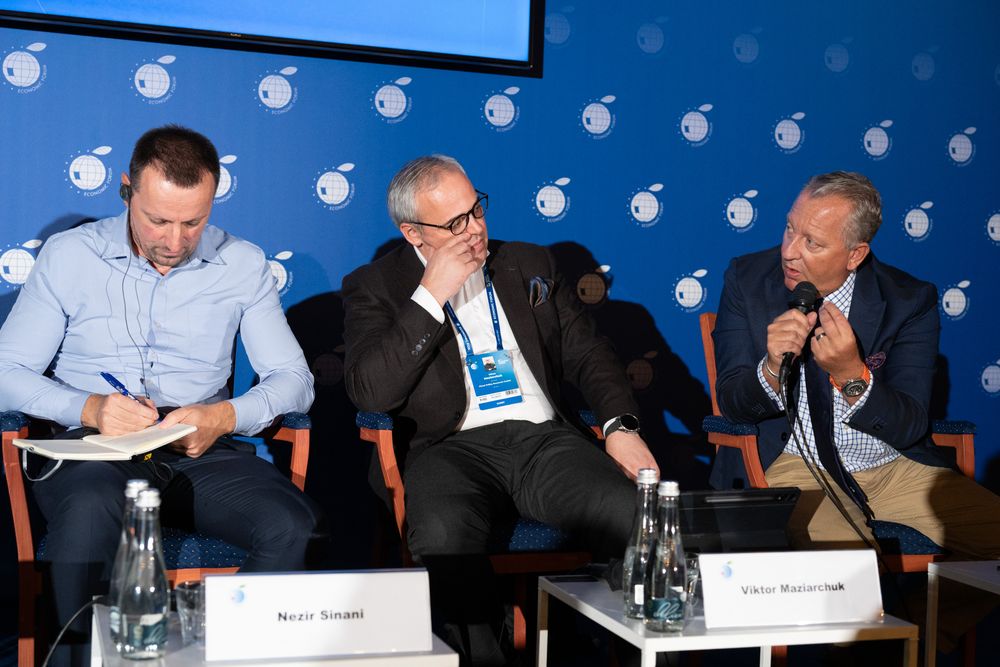
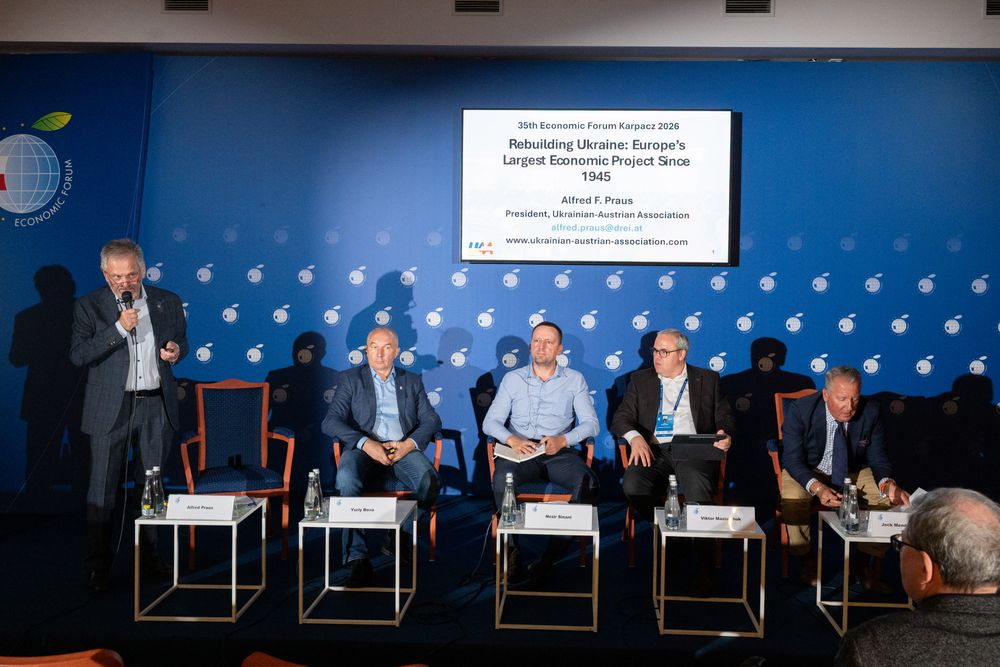
At the 35th Economic Forum in Karpacz, Poland, B4Ukraine Executive Director Nezir Sinani addressed a crucial question for Ukraine’s reconstruction: what kind of investors does Ukraine want?
Ukraine needs hundreds of billions in investment — but rebuilding Ukraine should not become a reputational washing machine for companies that continue doing substantial business in Russia.
Investment is not absolution. For companies whose conduct has contributed to harm, the conversation may need to go further still: toward remedy and, ultimately, reparations.
Full speech:
We are here to discuss how to attract investment into Ukraine, and there is no question about the scale of that need.
Ukraine will require hundreds of billions of dollars of public and private capital to rebuild its economy, infrastructure and communities.
But alongside the question “How do we attract more foreign investment?”, I think Ukraine, and all of us, should be asking another:
What kind of investors do we want to participate in Ukraine’s reconstruction?
Because not every investment should automatically buy a company the reputation of being a supporter of Ukraine. There is an uncomfortable contradiction today.
Some multinational companies continue substantial operations in Russia, earning revenues there, paying taxes there and contributing to the Russian economy, while simultaneously making donations or investments in Ukraine and presenting those activities as evidence of their solidarity with Ukrainians.
Ukraine should welcome genuine investment. But reconstruction cannot become a reputational washing machine.
Trostianets illustrates the dilemma perfectly
The city of Trostianets gives us perhaps one of the clearest examples. Mondelez had an important factory there. It was badly damaged after Russia’s invasion. Mondelez subsequently invested around $20 million to rebuild the plant. For Trostianets, that investment matters. The jobs matter. Restoring economic activity to a community devastated by war matters. And none of us should minimize that.
But Mondelez also chose to remain in Russia. Its Russian business has continued generating well over a billion dollars in annual revenues and paying hundreds of millions of dollars in profit taxes.
And this year the contradiction became almost surreal: Russia struck the Trostianets factory again.
So we effectively have a company rebuilding in Ukraine what Russia is destroying, while continuing a substantial business operation inside Russia that pays taxes to the Russian government funding its war.
That raises a question that goes far beyond Mondelez:
Can a company really present rebuilding in Ukraine as corporate responsibility while continuing business as usual in the economy of the aggressor?
The answer cannot simply be: “But we also help Ukraine”
This is where the recent report Which Businesses Owe Reparations for Staying in Russia?, produced by the Essex Business and Human Rights Project and supported by B4Ukraine, becomes important.
Its starting point is the UN Guiding Principles on Business and Human Rights. And the distinction it draws is crucial.
Corporate social responsibility, donations, philanthropy, rebuilding projects, is voluntary. Business and human-rights responsibility is different.
It concerns what a company must do when its activities cause, contribute to, or are directly linked to adverse human-rights impacts.
That means a company cannot answer questions about the consequences of its activities in Russia simply by pointing to the good things it is doing somewhere else. You cannot offset one against the other.
Paying taxes in Russia is not automatically a neutral act
One of the most important findings of the report is that businesses should not assume that paying taxes is a neutral act in a conflict like this.
Companies operating in Russia should assess whether their continued economic activity and tax payments are helping maintain or prolong the illegal situation created by Russia’s invasion. And they should weigh any legitimate argument for remaining, for example, providing genuinely essential goods, against the role their economic contribution may play in sustaining Russia’s war economy.
The report therefore rejects the comforting assumption that simply because a company is not producing weapons, its presence in Russia has nothing to do with the conflict.
Context matters. Scale matters. Duration matters.
And what the company knows about the consequences of remaining matters.
Time also changes corporate responsibility
There is another very important point in the report. Corporate responsibility is not static. A company might initially be considered merely directly linked to particular harms.
But when a conflict continues year after year, the violations are widespread and systematic, and the consequences of remaining in the Russian economy become increasingly clear, continued presence can potentially move a business further along the responsibility continuum.
The report concludes that staying in Russia for an extended period may move a business from being directly linked to the harm toward contributing to it.
And that distinction matters enormously.
Because under the UN Guiding Principles, where a company causes or contributes to adverse human-rights impacts, a responsibility to provide or cooperate in remediation can arise. We are now approaching five years of full-scale war.
Businesses cannot credibly say that they are still trying to understand the consequences of their choices.
Donations are not reparations
This is why I think the conversation about businesses supporting Ukraine needs to change.
We often hear companies announce:
We donated several million euros to Ukraine. We rebuilt a school. We supported refugees. We rebuilt our factory.
Those things can be genuinely valuable. But they are philanthropy. They should not automatically be confused with remedy. And they certainly should not be used as a reputational offset for the company’s continuing activities in Russia.
The Essex report goes significantly further.
It concludes that businesses that stayed in Russia may be liable to provide reparations if it can be established that they caused or contributed to gross violations of international human-rights or humanitarian law.
And it argues that, as part of a comprehensive and victim-centred reparations programme, companies that remained when they should have left should make appropriate contributions. That is a fundamentally different proposition from corporate charity.
It is the difference between:
“We would like to help Ukraine.”
and
“We have a responsibility toward those affected by the consequences of our business decisions.”
And Mondelez is not alone
The point here is not to single out one company. PepsiCo continues a very substantial Russian business. Rockwool remained in Russia for years while simultaneously highlighting its large contribution to Ukrainian reconstruction. Raiffeisenbank is on the same ship.
Mondelez has emphasized its rebuilding and investment in Ukraine while continuing substantial operations in Russia. There are many others.
Collectively, foreign companies that remained in Russia have generated enormous revenues and paid in average around 20 billion euros per year in taxes since the full-scale invasion.
So when a company announces a €5 million, €10 million or €20 million Ukrainian initiative, we should look at the whole balance sheet.
What has it contributed in Ukraine?
But also:
- What has it earned in Russia?
- How much tax has it paid there?
- What has it done to reduce its involvement?
- Has it conducted genuine heightened human-rights due diligence?
And:
Has it considered whether it now has a responsibility to contribute to remedy?
What should Ukraine and its partners do with this?**
For me, there are three practical implications for reconstruction.
First, Ukraine should distinguish between investment and reputational rehabilitation. Companies should absolutely be encouraged to invest there. But rebuilding a factory or financing a community project should not erase scrutiny of the company’s conduct elsewhere. Responsible investment needs to be assessed across the company’s operations.
Second, access to publicly supported reconstruction should increasingly reflect corporate conduct. When companies seek Ukrainian government contracts, international financial guarantees, development-bank financing, political-risk insurance or other forms of public support for reconstruction, their continued activities in Russia should be relevant.
Governments should be asking:
- Has this company responsibly disengaged from Russia?
- Has it undertaken heightened human-rights due diligence?
- Does it continue making substantial contributions to the Russian economy?
- And, where appropriate, has it contributed to remedy?
Ukraine’s partners should develop incentive programs that support companies that have made the choice of leaving the Russian market and are instead choosing to reinvest in Ukraine. And, on contrary, introduce deterrent measures such as financial penalties, restriction to access to contracts and exclusion from public procurement opportunities for companies that have decided to stay in Russia.
Third, we need to begin integrating corporate responsibility into Ukraine’s wider reparations architecture. Russia obviously bears primary responsibility for the destruction it has caused. Nothing should distract from that.
But that does not mean Russia is necessarily the only actor with responsibilities. Where businesses have caused or contributed to conflict-related harms, the question of corporate remediation should also be examined.
And the report makes another important recommendation: the home states of multinational companies should not simply leave this to voluntary corporate decisions. They should regulate their companies and create mechanisms allowing appropriate business contributions to Ukrainian reparations programmes.
Closing
Ukraine desperately needs investment. And I want multinational companies to build factories there, employ Ukrainians, provide technology and capital, and help reconstruct communities like Trostianets. But there should be one important distinction.
Investment is not absolution. A company cannot write a cheque in Ukraine and assume that the cheque cancels everything happening elsewhere in its business.
And after nearly five years of full-scale war, companies continuing substantial business in Russia can no longer plausibly treat that choice as disconnected from the conflict.
So perhaps the question for companies looking at Ukraine’s reconstruction should not only be:
“What investment opportunity is available to us?” It should also be: “What responsibility do we have toward Ukraine?”
For some companies the answer will simply be: invest. For others it should be: invest responsibly and leave Russia now.
And for companies whose conduct has contributed to harm, the conversation may need to go further still: toward remedy and, ultimately, reparations.