


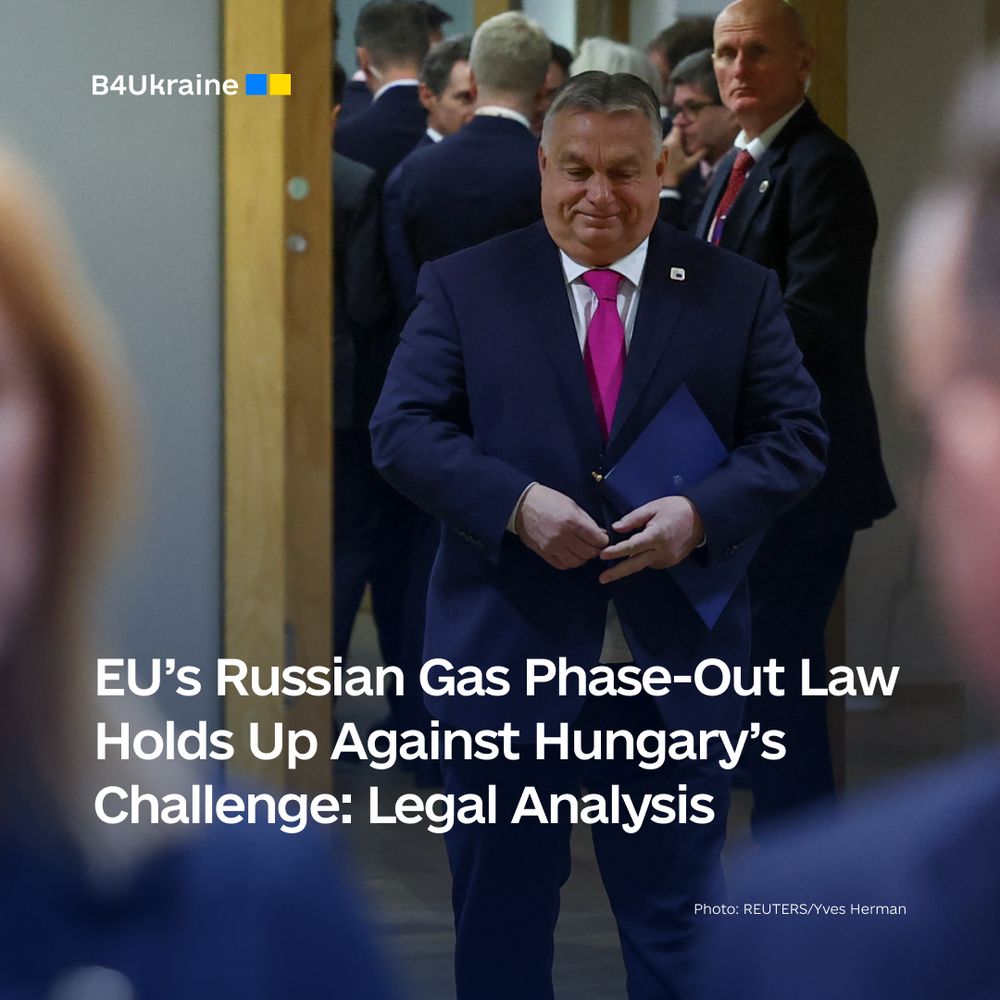


Following Hungary’s lawsuit at the European Court of Justice, a new legal analysis finds that the EU’s regulation phasing out Russian gas imports—and preparing to phase out Russian oil—is not an overreach but a constitutionally defensible exercise of EU power.
In a pro bono analysis prepared for B4Ukraine, experts at the Spanish law firm Regula said the regulation is structured to respect key EU legal principles, including proportionality, subsidiarity and energy solidarity, by introducing a gradual phase-out and national flexibility. As a result, it appears to comply with EU treaty rules governing energy and trade policy.
Viewed in this light, Hungary’s lawsuit looks less like a genuine legal challenge and more like a political gesture aimed at preserving a special relationship with Moscow, which has been enriching foundations linked to Prime Minister Viktor Orban, rather than providing cheaper energy to the Hungarian consumer.
A recent analysis by the Center for the Study of Democracy conducted together with the Centre for Research on Energy and Clean Air (CREA) shows that despite importing cheaper Russian oil, domestic fuel prices in Hungary were on average 18% higher than in neighboring Czechia in 2025, even though Prague purchases costlier non-Russian alternatives.
The report also finds that despite alternative supplies being available, Hungary now receives 92% of its crude oil from Russia—up from 61% before the full-scale invasion of Ukraine.
The findings strengthen the case for the European Union to pass legislation proposed by the European Commission to ban Hungary’s and Slovakia’s imports of Russian crude oil as soon as possible.